By the YFM Uniforms team — school uniform manufacturers with 15+ years of experience supplying schools across India. Last updated September 2026.
Quick answer: Good school uniform design starts with the school’s identity and the realities of the day — climate, age groups, sport, budget — and moves through a clear sequence: brief, colour palette, silhouettes, fabrics, crest and trims, sampling and wear-testing, and a phased rollout. Designs fail when schools jump straight from a mood board to bulk production.
Key takeaways
- Write a design brief before looking at a single swatch.
- Limit the palette to two or three colours that work across every garment.
- Design for the youngest and the oldest student separately.
- Wear-test samples for at least two weeks before approval.
- Plan a phased rollout so parents are not forced to replace everything at once.
A new or refreshed uniform is one of the few decisions that every family in the school feels immediately. Done well, it strengthens the school’s identity, makes students comfortable and gives parents confidence. Done poorly, it becomes a year-long source of complaints. This guide walks through the design process we follow with schools, from the first conversation to the day students wear the new uniform.
Stage 1: Write the design brief
Before discussing colours, agree on what the uniform must achieve. A good brief answers:
- Identity: What should the uniform say about the school — heritage, modernity, sport, academic rigour, global outlook?
- Users: Which age groups, from pre-primary to senior school? Any boarding students?
- Climate: How hot are summers, how cold are winters, how wet is the monsoon?
- Activities: How much of the day is spent on sport, labs, art or outdoor learning?
- Inclusivity: Options for trousers and skirts, modest wear, adaptive needs.
- Budget: What is a reasonable annual spend per family for the complete set?
- Timeline: When must students be wearing it, and will there be a transition period?
Stage 2: Build the colour palette
Most strong school uniforms use a primary colour, a secondary colour and a neutral. Choose colours that:
- Relate to the school’s crest and branding.
- Hide everyday dirt reasonably well — pure white and very pale colours need more care.
- Are available as stable, colour-fast dyes across different fabrics (a navy in a shirting, a knit and a suiting must match closely).
- Photograph well for admissions and events.
Ask your manufacturer to show the palette on real fabrics side by side, in daylight, before you commit.
Stage 3: Decide silhouettes for each age group
A single design rarely suits a four-year-old and a seventeen-year-old. Typical structure:
| Stage | Design priorities | Common garments |
|---|---|---|
| Pre-primary | Comfort, easy dressing, safety | Polo T-shirts, elastic-waist shorts or skirts, pinafores, velcro or elastic closures |
| Primary | Durability, growth allowance | Shirts, shorts or trousers, skirts or pinafores, sweaters |
| Middle school | Smart look, active wear | Shirts, trousers, skirts or culottes, ties, sweaters, tracksuits |
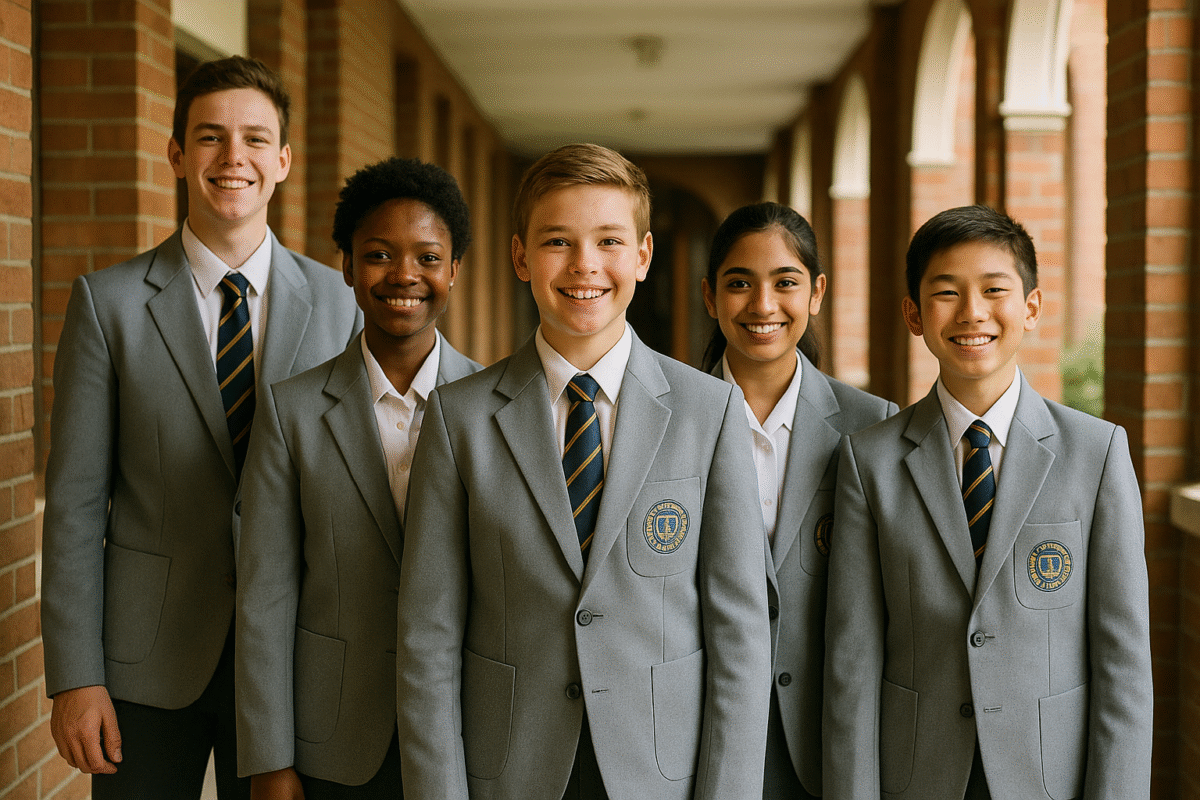
| Senior school | Formal identity, distinction | Blazers, ties, trousers or skirts, optional salwar-kameez or trousers for girls |
Stage 4: Choose fabrics per garment
Fabric choice should follow the garment and the climate, not a single preference. See our detailed guide to the best fabric for school uniforms for blends, weights and test specifications.
Stage 5: Crest, trims and details
Details make the difference between a generic uniform and a premium one:
- Crest method: embroidery for blazers and sweaters; woven badges for a sharp finish; high-quality prints on sportswear where embroidery would be heavy.
- Trims: contrast piping, tipping on sweater cuffs and collars, house-colour stripes on ties.
- Buttons and zips: durable, securely attached, sized for small hands in junior grades.
- Labels: care labels plus space for a name label to cut lost property.
Stage 6: Sampling and wear-testing
Order samples of every garment in two or three sizes. Ask a group of students across age groups to wear them for at least two weeks, and wash them at home in the normal way. Collect feedback on comfort, fit, heat, ease of dressing and how the garment looks after washing. Revise, and seal the approved version as a golden sample.
Stage 7: Consult, communicate and roll out
Share the final design with parents with clear reasons for the change, a price list and a transition plan. A phased rollout — new students and one or two grades first, with the old uniform allowed for a year — keeps goodwill and spreads cost for families.
Design mistakes to avoid
- Choosing colours from a screen rather than from fabric.
- Designing only for the senior-school photograph.
- Adding too many unique garments that raise the cost of the full set.
- Ignoring winter layering until November.
- Skipping the wear test.
How YFM supports uniform design
YFM works with schools from design and sampling to production and delivery. Our team helps translate a school’s identity into a practical uniform wardrobe, develops samples in the approved colours and fabrics, and manages the rollout — including a school-branded online store where parents can order the new uniform.
Frequently asked questions
How do you design a school uniform?
Start with a written brief covering identity, age groups, climate, activities, inclusivity, budget and timeline. Then agree a colour palette, choose silhouettes for each age group, select fabrics per garment, finalise the crest and trims, wear-test samples and plan a phased rollout.
How many colours should a school uniform have?
Usually two or three: a primary colour, a secondary colour and a neutral. Fewer colours are easier to match across fabrics and keep costs down.
How long does it take to design a new school uniform?
Allow three to four months from brief to approved golden samples, and another two to three months for production before the session starts.
Should parents be consulted on a new school uniform?
Yes. A short consultation on comfort, cost and practicality builds acceptance. Final design decisions still rest with the school.
Planning uniforms for your school’s next session?
YFM Uniforms designs, samples, manufactures and delivers complete school uniform programmes — from blazers and sweaters to sportswear and staff uniforms — with a school-branded online store for parents. Share your requirement and our team will come back with fabric options, samples and a detailed quotation.